MIDI has been the backbone of music technology for over four decades. Now, with MIDI 2.0 firmly in motion, the protocol that connects instruments, software, and studios is getting its most significant upgrade yet.
MIDI 2.0: An Extension, Not a Replacement
MIDI 2.0 doesn't throw out everything that came before. It's built as a direct extension of MIDI 1.0, preserving the familiar concepts — channels, notes, controllers, program changes — while dramatically modernising how those messages are expressed and exchanged.
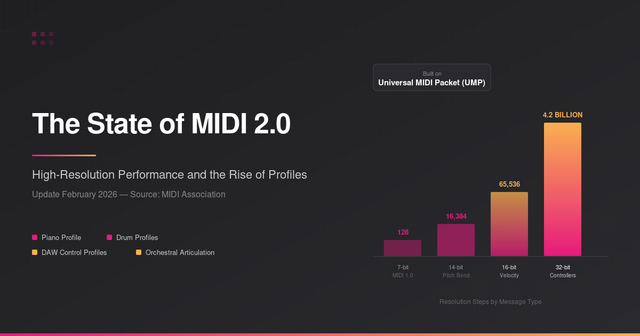
The two headline improvements are high-resolution Channel Voice Messages, where controls jump from 128 steps to roughly 4.2 billion and velocity from 128 to 65,000, and Profiles — standardised behaviour contracts that let devices discover, negotiate, and agree on how to interpret messages without manual mapping or guesswork.
Underpinning both is the Universal MIDI Packet (UMP), a modern container format that carries both MIDI 1.0 and MIDI 2.0 data, and MIDI-CI, a bidirectional negotiation system that lets devices identify shared capabilities and auto-configure accordingly.
Why Resolution Matters
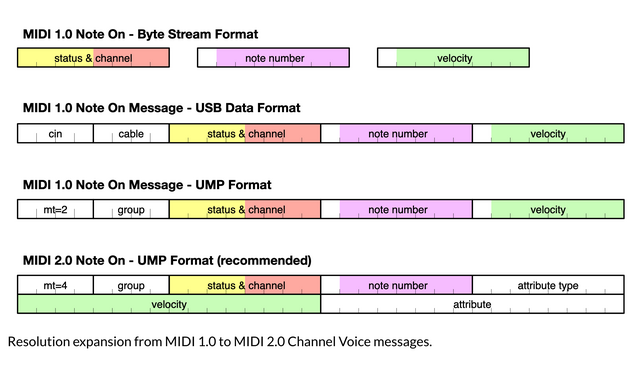
MIDI 1.0's 7-bit data range was revolutionary in 1983. Today, it's a bottleneck. MIDI 2.0 expands every key dimension:
| Message Type | MIDI 1.0 | MIDI 2.0 |
|---|---|---|
| Note velocity | 7-bit (0–127) | 16-bit (0–65,535) |
| Control Change | 7-bit (0–127) | 32-bit (4.2 billion steps) |
| Pitch Bend | 14-bit (0–16,383) | 32-bit |
| Aftertouch (channel and poly) | Low-resolution | 32-bit per note |
The result: smoother fades, more expressive playing, and better sensor fidelity across hardware and software instruments alike. For anyone running MIDI automation on a digital console or controlling parameters during a live show, this eliminates the audible stepping and zipper noise that has plagued continuous controls for years.
Profiles: Negotiated Interoperability
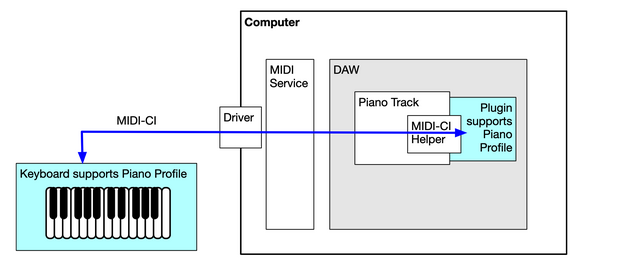
Where MIDI 1.0 assumed devices would just work together, MIDI 2.0 formalises that agreement. Profiles are negotiated via MIDI-CI — devices query each other, confirm support, and enable a shared behavioural contract. If it's on, both sides know exactly what every message means.
Several key Profiles were showcased at NAMM 2026:
Piano Profile
Standardises velocity curves, pedal behaviours (sustain, sostenuto, soft, half-pedal), and registered controllers for piano devices. Whether you're using a digital piano, an acoustic with MIDI, or a software instrument, the Piano Profile ensures consistent feel and response across manufacturers.
For touring keyboard players, this is significant — swap out a controller mid-tour and the replacement understands the rig immediately. No reprogramming velocity curves. No remapping pedal behaviour.
Drum Profiles
The Default Drum Note Map Profile locks in standardised note-to-sound assignments (kick, snare, hi-hats, toms, cymbals), so drum sequences transfer between devices without remapping. The broader Drum Performance Profile adds expressive capabilities — cymbal choke, positional sensing, gesture types like rim shot and cross stick — previously buried in proprietary SysEx.
DAW Control Profiles
These replace proprietary control surface protocols (Mackie Control, HUI, manufacturer-specific implementations) with standardised, modular Profiles for transport control, dynamic parameter mapping, and mixing. Three are in development: a Function Block Transport Profile, a Single Channel Dynamic Control Profile, and a Function Block Mixing Profile.
For production companies running different software across different projects, this means one control surface that works identically across every DAW without configuration. That's a meaningful workflow improvement.
Orchestral Articulation Profile
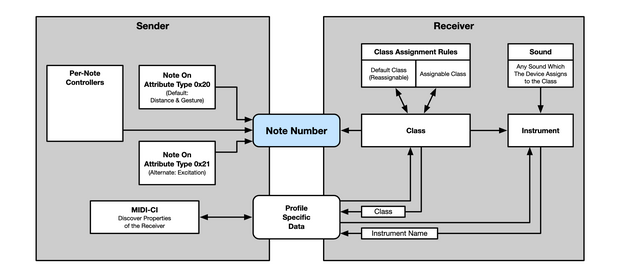
Articulation information — staccato, legato, col legno — is now encoded directly in the MIDI 2.0 Note On message itself, using Attribute Type and Attribute Data fields. This eliminates hidden keyswitch notes and means articulated passages remain meaningful when copied across tracks or swapped between sample libraries.
Plugins and DAWs: Open-Source Help on the Way
The MIDI Association is working with Apple, Avid, Bitwig, Steinberg, and JUCE to develop open-source software that bridges MIDI 2.0 external devices with existing plugin formats (AU, AAX, CLAP, VST). This means plugin developers can add MIDI 2.0 support without deep knowledge of the underlying protocol, lowering the barrier to adoption across the industry.
Radical Events is a member of the MIDI Association and actively tracks these developments as they affect the live production tools and workflows we use daily.
File Formats: MIDI 2.0 Beyond Live Performance
MIDI 2.0 isn't just a transport protocol. Two new file specifications ensure high-resolution data is preserved in storage and exchange:
MIDI Clip File (M2-116) stores Universal MIDI Packets directly, preserving full 32-bit resolution, Profile semantics, and articulation data without downscaling. The SMF2 Container Format wraps MIDI Clip files alongside audio, notation, and metadata in a single project file, while maintaining backward compatibility with existing workflows.
This matters for session transfer between studios and DAWs — no more losing expression data or articulation mappings when moving projects between platforms.
The Bottom Line
MIDI 2.0 is a thoughtful, well-engineered evolution. It dramatically increases expressive resolution, introduces a formal negotiation layer that eliminates compatibility guesswork, and preserves everything that made MIDI 1.0 the universal language of music technology.
With finalised core specs, published Profiles, and open-source tooling in development, MIDI 2.0 has moved from architectural vision to practical reality. The question now isn't whether it will be widely adopted — it's how quickly.
The full technical breakdown is available on the MIDI Association website.